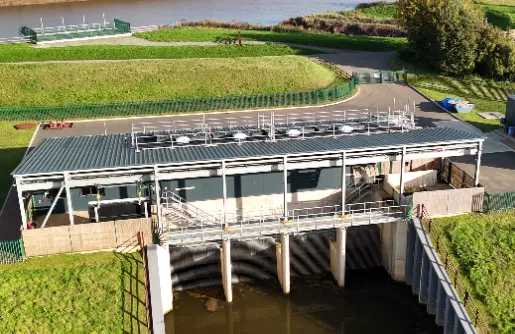

Defra’s £830m flood and coastal erosion risk management (FCERM) programme allocation for 2026/27 gives Internal Drainage Boards (IDBs) a practical opportunity to modernise telemetry across pumping stations, sluices, penstocks, level monitoring points, and the broader “hard-to-reach” asset base that usually generates call-outs at awkward times.
For most Boards, the real issue is not whether funding is available, but how to turn that funding into measurable operational resilience: fewer avoidable site visits, clearer prioritisation during events, and a more defensible audit trail for decisions made under pressure.
This post takes a straightforward, engineering-led look at how IDBs can use the 2026/27 funding window to invest in Sitewatch Anywhere telemetry, with a focus on remote monitoring, real-time alerting, and data-driven maintenance. It also explains why the updated guidance point that asset refurbishments can be 100% funded is worth paying attention to when telemetry is treated as part of the asset improvement scope, rather than a bolt-on extra.
Note: IDBs should always confirm eligibility and scope with the relevant Defra/EA programme guidance and local approving authority for the specific scheme. The intent here is to outline a proven technical approach to “spend well” on resilience outcomes.
1) The operational problem IDBs are trying to solve
Across IDB districts, the same constraints keep appearing:
- Distributed assets over large geographies, frequently in remote or low-access locations.
- Power constraints (no mains available at outfalls and structures) and limited communications options.
- A heavy reliance on routine visits to confirm “all OK” status, especially outside pumping stations where inland level risk is driven by tide-locking, rainfall intensity, and localised blockages.
- During rainfall and tide events, the operational mode becomes reactive: teams are dispatched because “something might be happening”, not because instrumentation shows what is happening.
Telemetry is often discussed as a general improvement, but the technical value is specific: it reduces uncertainty. The correct objective is not “more data”; it is actionable signals: alarms, trends, and status that translate directly into dispatch decisions and maintenance prioritisation.
2) Why the £830m allocation matters specifically for telemetry
Funding rounds typically create two behaviours:
- capital works that are easy to specify and procure, and
- digital improvements that get postponed “until next year”.
The 2026/27 position is useful because it encourages Boards to treat monitoring upgrades as a core element of asset refurbishment (not an operational add-on). If refurbishment scopes can be 100% funded, telemetry can be packaged correctly as:
- instrumentation replacement or enhancement,
- new status/condition monitoring,
- improved resilience (e.g., comms/power upgrades),
- reduced operational risk through earlier detection.
In practice, this means a pump station refurbishment does not have to stop at MCC/panel works and mechanical overhaul; it can include the “eyes and ears” that make the refurbished asset easier to operate for the next 10–15 years.
3) The technical approach: problem → solution → benefit
Problem: limited visibility between visits
For many Boards, the interval between physical checks is still the dominant “sensor”. That works until it doesn’t: particularly when:
- a level rises quickly overnight,
- an outfall becomes tide-locked longer than expected,
- a pump trips but no one knows until the next visit or a phone call.
Solution: Sitewatch Anywhere telemetry as a standard layer across the district

Caption: A Sitewatch SCADA dashboard providing a high-level overview of multiple pumping stations across a district.

Caption: Real-time alerts on a tablet—allowing duty engineers to identify a tripped pump instantly from anywhere.
Sitewatch Anywhere is a cloud-based telemetry service operated by LEE-DICKENS Ltd., designed so authorised users can access live status via a browser (phone/tablet/PC) without taking on additional IT infrastructure.
Core building blocks typically include:
- level monitoring (ultrasonic, pressure, radar as appropriate),
- digital status and fault inputs (pump run/trip, door, intrusion, high level),
- optional analogue measurements (pressure, power parameters),
- remote diagnostics and event history,
- alarm routing and escalation.
Sitewatch Anywhere service entry point:
Related company context and services:
- LEE-DICKENS Ltd. main site: https://www.lee-dickens.co.uk
- Cloud-based monitoring service page (navigation reference): https://www.lee-dickens.co.uk/services/cloud-based-monitoring
- Telemetry & monitoring product area (navigation reference): https://www.lee-dickens.co.uk/products/telemetry-and-monitoring
Benefit: fewer “unknowns”, better dispatch decisions, better evidence
The operational benefit is not abstract. It is specifically:
- real-time alerts rather than discovery-by-visit,
- trend context (is level stable, rising, or oscillating?),
- improved tasking: crews go where attention is needed,
- a defensible record of what was seen and when, which matters after events.
4) What “future-proofing” looks like in real IDB deployments

Future-proofing in an IDB context is rarely about a single big system. It is about standardising a telemetry pattern that scales.
4.1 Remote locations: solar-powered monitoring at outfalls

Caption: A Lee-Dickens remote telemetry station powered by solar energy—ideal for tidal outfalls and remote monitoring points without mains power.
A common blocker is mains power at tidal outfalls. That is exactly where instrumentation is needed most, because the inland level behaviour can change rapidly with tide and rainfall interaction.
South Holland IDB deployed Micro Solar Packs (MSPs) reporting into their web-based Sitewatch pump station application at tidal outfall sluices, specifically because AC-powered alternatives were not economically justifiable in those locations. The units provided 15-minute updates (96/day) over cellular communications, supporting year-round monitoring without routine “just to check” site visits.
“The Micro Solar Pack enabled us to monitor our sluices at an affordable cost, providing us with regular water level updates throughout the year for a fraction of the cost.”
Karl Vines, Catchment Engineer, South Holland IDB
The key technical point is that solar-based telemetry is not a compromise when the system is engineered correctly; it is often the only viable way to create visibility in the parts of the network that drive the most uncertainty.
4.2 Quick wins: start with one station and expand
Feldale IDB provides a pattern that suits many Boards: start with a small telemetry deployment at a pumping station using cellular telemetry, subscribe to Sitewatch Anywhere, and then use the operational learning (alerts, trend behaviour, call-out reduction) to prioritise the next sites.
That model aligns well with a funding year because it allows:
- early delivery on a subset of assets,
- proof of operational benefit,
- phased expansion with a standard spec.
Reference: Official Reference: £1.4bn flood investment unleashed to protect homes and businesses – GOV.UK
5) Mobile Visual Verification: CCTV in Your Pocket

Caption: Visual verification via integrated CCTV—offering a live view of drainage channels and sluice gates as a complementary mobile tool alongside Sitewatch Anywhere.
Sitewatch Anywhere provides the telemetry data, alarm handling, trends, and alerting layer, while the integrated PTZ (Pan-Tilt-Zoom) HD colour CCTV is viewed through a dedicated selection in a smartphone app.
In practice, an operative can receive an alert in Sitewatch Anywhere, then immediately switch to the CCTV app on a phone or tablet to visually verify site conditions. That gives the team practical “eyes on the ground” wherever they are, whether in the office, at home, or already out on-site.
This makes it straightforward to:
- verify weed screen condition, water levels, and pump structures before deciding whether a visit is needed,
- check site status for security and lone working safety in line with HSE considerations,
- confirm environmental conditions before and after remote operations.
It works as a complementary mobile tool alongside Sitewatch Anywhere rather than as a direct in-dashboard video view, which is often the more practical arrangement for mobile operational teams making time-critical decisions.
6) Turning funding into a telemetry specification (without overcomplicating it)

Caption: Sitewatch Schematic Geographical Overview: A professional SCADA dashboard showing a logical schematic of watercourse levels and asset statuses across a drainage district.
To make telemetry spend defensible under a refurbishment or improvement programme, it helps to specify in operational terms rather than “install telemetry”.
A practical specification format IDBs can use:
6.1 Measurement and status points (typical)

Caption: A typical wall-mounted ultrasonic level sensor installation for non-contact monitoring.
- Upstream level (primary, referenced to ODN (Ordnance Datum Newlyn) where applicable) and downstream/tide level (where relevant)
- Pump run / pump trip / pump available status
- High-high level alarm (independent threshold)
- Door open / intrusion (where appropriate)
- Battery/solar health (for off-grid installations)
- Communications health (heartbeat, last update timestamp)
6.2 Update intervals and event behaviour
- Routine update interval suitable for catchment dynamics (commonly 15 minutes for level sites where rapid change is plausible)
- Event-driven uploads on alarm state change (trip/high level/door)
- Time synchronisation and a retained event log for audit
6.3 Alarm routing and escalation
- Role-based notifications (duty officer, operations team, on-call)
- Escalation if alarm not acknowledged within set time
- Clear alarm rationalisation (avoid nuisance alerts)

6.4 Data ownership and access
- Secure user accounts with role-based access
- Exportable trends for reporting and post-event review
- A clear record of configuration and change control (important for long-lived infrastructure)
7) How Sitewatch Anywhere supports data-driven decisions during events
During rainfall/tide events, the question is “what is happening now, and what should be done next?”
Telemetry supports this in three direct ways:
-
Situational awareness across the district
Instead of ringing round or driving round, the duty engineer can see which assets are stable and which are deteriorating. -
Faster fault isolation
If a pump trips, the timestamped event combined with level behaviour often indicates whether the trip is consequential (level rising) or incidental (redundant capacity available). That changes the dispatch priority. -
Post-event review and maintenance prioritisation
Trend histories show which stations ran hardest, which sites sat tide-locked longest, and which sensors/structures were borderline. That feeds directly into winter maintenance and refurbishment planning.
The operational stance becomes proactive, because crews are sent based on evidence rather than uncertainty.
8) Where the “100% refurbishment funding” point can be used properly
The Boards that get best value from funding typically treat telemetry as part of:
- pump station refurbishment (panel/MCC upgrade plus monitoring),
- structure refurbishment (sluice/penstock works plus level sensing),
- comms resilience (cellular with appropriate antennaing, resilience planning),
- safety and access improvements (reduce unnecessary site exposure during storms).
This is not about dressing telemetry up as something it isn’t; it is about acknowledging that an asset upgrade without visibility often leaves the operational burden unchanged. A refurbished station that still requires frequent “prove it’s running” visits is not optimised for modern operational constraints.
9) A pragmatic rollout plan for IDBs (2026/27 funding year)
Phase 1 : Site selection and comms/power survey (2–4 weeks)
- Identify 5–15 priority assets: highest call-outs, highest consequence, least visibility
- Confirm cellular coverage and antenna requirements
- Confirm power: mains vs solar requirements
Phase 2 : Pilot installation and alarm tuning (4–8 weeks)
- Install telemetry, commission I/O points
- Configure dashboards and alarm thresholds
- Run through one rainfall event cycle and tune nuisance alarms
Phase 3 : Standardisation and scale-out (remainder of year)
- Freeze a standard telemetry I/O schedule per asset class (pump station, outfall, level site)
- Roll out in batches with consistent commissioning and documentation
- Align outputs with reporting needs (programme evidence, maintenance planning)
This pattern keeps delivery achievable inside a funding year and reduces the risk of large-spec systems that take too long to implement.
10) Next steps for IDBs
- Use the funding window to define telemetry as a refurbishment deliverable with a measurable operational outcome (alerting coverage, visit reduction, response time improvement).
- Start with assets where telemetry removes the most uncertainty: tide-affected outfalls, high-consequence pump stations, and remote level points.
- Build the telemetry layer as a repeatable standard, not a one-off project.
For Sitewatch Anywhere discussions relevant to IDBs: levels, pump stations, tidal outfalls, solar deployments: contact LEE-DICKENS Ltd. via the main site:
https://www.lee-dickens.co.uk
What Next?
If an Internal Drainage Board is planning 2026/27 funding work, a sensible next step is to identify the assets where telemetry and visual verification will remove the most uncertainty, then talk through a practical deployment approach. LEE-DICKENS Ltd. can provide a Sitewatch Anywhere demonstration and discuss suitable options for pump stations, tidal outfalls, remote level points, integrated CCTV, and wider refurbishment-linked monitoring projects. To arrange a chat or book a demonstration, call the office on +44 (0) 1536 760156 or email sales@lee-dickens.co.uk.
About LEE-DICKENS Ltd.
LEE-DICKENS Ltd. (www.lee-dickens.co.uk) has delivered high-integrity industrial and military process monitoring and control systems since 1962, specialising in bespoke engineering, telemetry and SCADA, and contract electronics manufacture. For IDBs and other operators managing dispersed assets, that means practical support with remote monitoring and control systems that are designed to be reliable, straightforward to deploy, and fit for long-term service in demanding environments. The Sitewatch platform supports remote monitoring and control of distributed assets, enabling clear status visibility, auditability, and dependable operational support where those requirements matter.
Leave a Reply