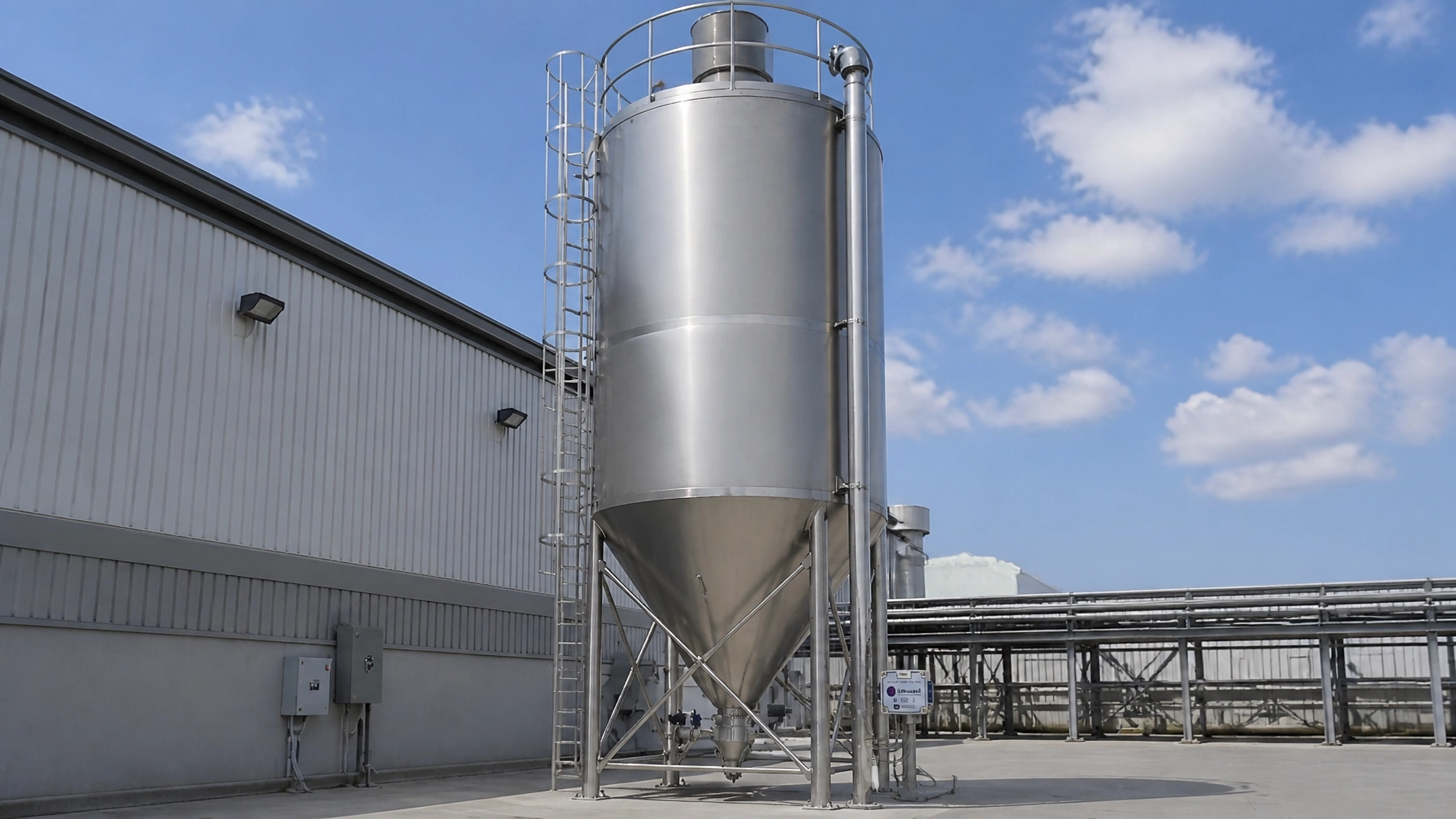
As outlined in the previous article, Smart Silo Monitoring: Revolutionising Inventory Management with Lee-Dickens, the commercial value of remote stock visibility is now well established. The engineering reality of Vendor Managed Inventory in food and powder handling, however, is determined less by the concept itself than by the quality of the measurement chain behind it. In practice, replenishment decisions are only as dependable as the field instrumentation, installation geometry, update interval, and data interpretation applied at the vessel.
For bulk powders and food liquids, the technical ground truths are straightforward. Deliveries cannot be scheduled accurately unless usable inventory is measured consistently across varying vessel geometries, changing product behaviour, and live production draw-off. Powders stored in vertical silos with conical discharge sections do not present a flat, stable surface to a sensor; liquids in horizontal cylindrical tanks do not convert linearly from level to volume without correct strapping or geometric compensation. Across both formats, telemetry must therefore be engineered around the physical storage asset, the product characteristics, and the operational delivery model rather than treated as a generic level indication exercise.
The monitored product range is not limited to flour and sugar. The same telemetry architecture is routinely applied to ingredients such as vinegar, citrus concentrates, palm oil, olive oil, malic acid, and glycerine, provided that the sensing method, process connection, and installation arrangement are selected to suit the medium and vessel configuration. In VMI environments, that level of engineering precision is not optional; it is the basis on which stock visibility, delivery planning, and supplier accountability are made technically credible.
The Strategic Importance of Bulk Ingredient Storage
A bulk ingredient vessel is often the primary buffer between raw material delivery and the production line. In a typical bakery or food-processing setting, a flour silo, edible oil tank, or liquid ingredient vessel may support several shifts of continuous operation. The failure to accurately track the depletion of that asset does not merely result in an administrative inconvenience; it leads to production interruption, emergency delivery surcharges, stock rotation problems, and potential waste of intermediate batches.
By implementing a VMI strategy supported by Sitewatch Anywhere, food manufacturers, ingredient suppliers, and logistics companies can work from the same live operational picture. This allows production teams to focus on manufacturing efficiency, gives suppliers a dependable basis for replenishment planning, and enables transport planners to schedule deliveries against real site demand rather than manual estimation. Even on sites with multiple silos or tanks, telemetry remains critical: it enables delivery sequencing to be optimised across the vessel group, reduces the likelihood of older stock remaining unused in a secondary vessel, and creates maintenance windows in which an individual silo or tank can be isolated without production planning being reduced to guesswork. In that respect, the system is a practical win-win across the full delivery cycle rather than a tool used solely by the vessel owner.

The Sitewatch Mini RTU: a compact telemetry interface that provides the monitoring intelligence, irrespective of vessel geometry, when paired with the appropriate field transducer.
Technical Challenges in Powder and Liquid Inventory Measurement
Monitoring powders such as flour or sugar is inherently more complex than liquid level sensing, although liquid vessels introduce their own geometric and installation constraints. The physical properties of bulk solids lead to several phenomena that can compromise the accuracy of a simple top-down level measurement, particularly in tall silos with conical hoppers.
Coning, Bridging and Ratholing
Powders exhibit a high angle of repose, which results in coning during the filling and discharge phases. As material is drawn from the conical bottom of the silo, a funnel-shaped void often forms in the centre, a condition known as ratholing, while the outer edges remain at a higher level. Conversely, moisture, compaction, or inconsistent particle behaviour can cause bridging, where the material forms a solid arch across the diameter of the silo, leaving an empty space above the discharge valve despite a high level reading at the top. Telemetry does not remove these flow characteristics, but historical usage patterns, refill response, and depletion anomalies can make them visible early enough for operations staff to intervene before a stock-out or false assumption of available inventory occurs.
Dust, Atmospheric Interference and Sensor Position
Pneumatic filling processes generate significant airborne dust within the silo headspace. This environment can attenuate ultrasonic signals and can also create difficult reflection conditions for non-contact sensors if the installation geometry is poor. For powders, weigh scale arrangements based on load cells are generally regarded as the gold standard, because total vessel weight is measured directly and the clogging, bridging, and irregular surface profile issues inherent in non-contact level methods are largely avoided. Where radar or ultrasonic measurement is used, the sensor should not simply be aimed down the centreline; for conical or uneven powder surfaces, mounting at approximately two-thirds of the radius from the centreline is typically preferred in order to obtain a more representative average height, rather than repeatedly measuring the peak or valley of the product cone.

Abstract technical representation of coning and bridging phenomena in powder silos.
Implementation of Sitewatch RTUs
To address these challenges, LEE-DICKENS Ltd. provides a specialised telemetry package centred around the Mini RTU and the MIDI-10 RTU. The Mini RTU is the monitoring intelligence rather than the storage asset itself: in engineering terms, it is the brain, not the bucket. It is designed for rapid integration with existing plant infrastructure and is well suited to monitoring one or two silos or tanks where a compact, localised telemetry node is required. The MIDI-10 RTU is the heavier-duty option for larger silo farms and denser installations where additional I/O capacity and broader site integration are needed. In practice, many food-production sites deploy a mix and match arrangement of Mini RTUs and MIDI-10 RTUs according to vessel layout, signal density, and the physical spread of the asset base.
The RTU interfaces with the selected field instrumentation, which may include load cell systems, radar transmitters, ultrasonic devices, pressure-based level instruments, or other process signals appropriate to the application. Levels are monitored live and in real time, with the RTU continuously observing process conditions so that no event is missed, while data logging runs alongside at configurable intervals, for example every 15 minutes, to create an accurate historical record for reporting, audit, and trend analysis. This dual approach provides immediate visibility for operational decisions while building a robust long-term dataset. It also allows a common telemetry architecture to be retained whether the monitored asset is a single 40-tonne flour silo, a horizontal cylindrical vinegar tank, or a multi-vessel edible oil installation served by a larger silo farm controller.
"The integration of Sitewatch telemetry onto our flour silos has transformed our logistical planning. We no longer rely on daily manual 'dipping' or weight estimations. The real-time visibility allows our suppliers to optimise their delivery routes, ensuring we are always topped up before a critical production run."
: Operations Director, UK Commercial Bakery Group
Sitewatch Anywhere: The VMI Dashboard
The data acquired by the RTU layer is presented through the Sitewatch Anywhere interface. This platform allows food manufacturers, ingredient suppliers, and logistics companies to monitor levels across multiple sites through a unified, secure portal.

The Sitewatch Anywhere interface provides live silo analytics for multi-silo food-production sites, including real-time status, estimated delivery amounts, and inventory planning insight for powders and liquids such as flour, white vinegar, and vegetable oil.
The dashboard is configured to provide:
- Live Status Updates: Real-time percentage and tonnage readings for each silo.
- Consumption Rate Analytics: Predictive modelling that estimates the time-to-empty based on current production speeds.
- Estimated Delivery Amounts: Calculated figures indicating how much product was included in the last delivery, derived from the recorded inventory immediately before and after the delivery window and adjusted for the average ongoing consumption during that period.
- Automated Alarms: SMS and email notifications triggered when levels breach pre-defined low or high setpoints.
- Historical Trending: Analysis of usage patterns to identify long-term efficiencies or supply chain bottlenecks.
Aggregate Silo Views
Where a site contains multiple silos holding the same ingredient, Sitewatch can present those vessels as a single aggregate or "virtual" tank within the dashboard. In practical terms, three separate 40-tonne flour silos can be grouped into one high-level inventory view, allowing suppliers, logistics planners, and manufacturer inventory managers to assess total flour availability across the whole installation rather than interpreting each vessel in isolation.
This aggregate view is particularly important for delivery planning and consumption analytics. It converts redundant storage capacity into a single operational data point, making it easier for logistics teams to schedule replenishment against the true site total and for manufacturer inventory managers to understand combined stockholding and depletion trends without losing visibility of the individual silos. At the same time, the underlying silo-level data remains available for operational decisions such as maintenance isolation, stock rotation, and individual vessel performance review.
Hardware Integration and Installation
For food-grade environments, hardware must be installed with minimal disruption and adhere to strict hygiene standards. Our installation and commissioning services ensure that sensors are mounted using appropriate process connections (e.g., DIN flanges or hygienic couplings) that prevent material ingress or bacterial growth.

Ultrasonic or radar sensors are securely mounted to provide non-contact, high-accuracy measurement.
Both the Mini RTU and the MIDI-10 RTU are housed in robust, IP65-rated enclosures suited to harsh industrial environments, including washdown conditions common in food production. The RTU footprint and mounting arrangement can therefore be selected to suit constrained positions around silo banks, tank farms, and mixed-ingredient storage areas without imposing on the mechanical design of the vessel itself.
Conclusion: Driving Efficiency through Data
The transition to a VMI model for food-production silos and tanks is a logical progression for manufacturers seeking to modernise their supply chains. By leveraging the technical expertise of LEE-DICKENS Ltd. and the reliability of the Sitewatch Anywhere platform, companies can mitigate the risks associated with manual inventory management and the physical complexities of both powder and liquid storage. The engineering emphasis remains on selecting the correct sensing strategy, integrating it cleanly with plant instrumentation, and delivering dependable telemetry intelligence to those responsible for supply continuity.
For over 60 years, LEE-DICKENS Ltd. has specialised in the design and manufacture of high-integrity process monitoring and control systems. From bespoke contract electronics manufacture to advanced telemetry and SCADA systems, we provide the technical foundation for critical infrastructure across the industrial, military, and utility sectors. Our Sitewatch Anywhere platform remains at the forefront of the IIoT revolution, offering unparalleled reliability for remote asset management.

About LEE-DICKENS Ltd.
Established in 1962, LEE-DICKENS Ltd. is a leading UK-based manufacturer of industrial electronics and process instrumentation. We provide fully bespoke engineering solutions, including signal conditioning, power monitoring, and the Sitewatch RCMS platform. Our expertise spans demanding environments, from Internal Drainage Boards to military defense contractors, ensuring long-term, reliable partnerships for critical infrastructure monitoring.
Leave a Reply